
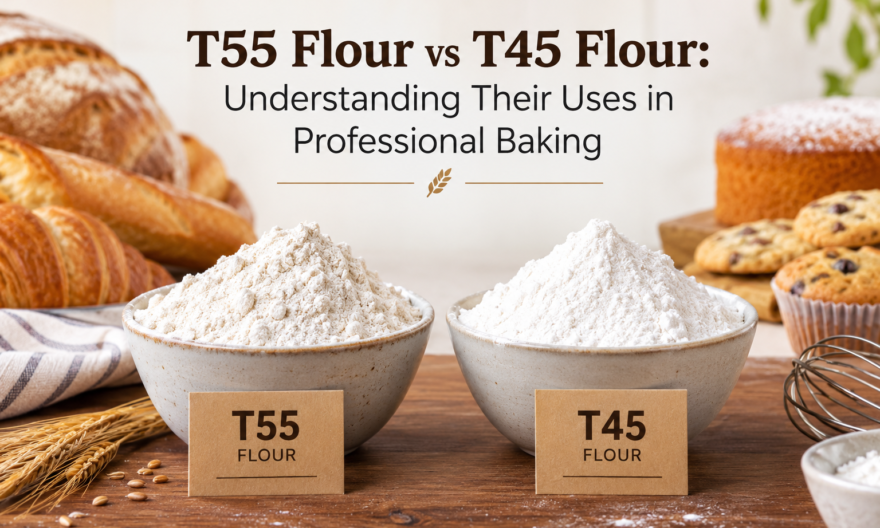
Flour selection influences dough processing, fermentation, and the texture and quality of the final product. For a professional bakery, it is essential to choose the right flour for the given recipe, considering several factors. In addition to the recipe, the flour’s intended use, processing conditions and overall requirements are significant. French flour classification is helpful in this case, as it serves as a primary reference for bakers, showing what bread types can be made from a particular category of flour.
For example, T55 flour is suitable for baking conventional bread, while T45 is primarily used for cakes, pastries, and pies. This classification is helpful for bakery owners, production managers & pastry chefs, who want to maintain consistency in their products, achieve the desired quality of baked goods, and match their characteristics to specific conditions and equipment.
Understanding French Flour Classification
French flour classification is based on the content of minerals, which is determined by burning a flour sample at a certain temperature until only ash remains. The resulting substance is weighed, and the percentage of ash gives the type of flour. Thus, the higher the number, the coarser the flour and the higher the mineral content. However, it should be noted that the system does not consider the proteins, gluten, and other valuable substances contained in wheat flour.
The choice of flour depends not only on the type and characteristics but also on the technology used and the conditions of flour production. Consequently, to obtain the desired qualities of the finished product, it is necessary to study both the characteristics of the available flour and the requirements for the chosen technology.
What Is T55 Flour?
T55 flour is the kind of flour people usually use for making bread, croissants and other everyday bakery stuff. Depending on how it’s made, it can be pretty good for doughs that need to hold together while you’re mixing, letting it rise, shaping it, and then baking it. Making bread is all about getting the flour and the way you handle the dough to work well together. The dough has to trap the air bubbles that form while it’s rising, but it also can’t be too sticky or stiff when you’re cutting it up and shaping the loaves. How much water you add, how long you mix it, and the conditions while it’s fermenting all make a big difference in how the bread turns out in the end.
Applications of T55 Flour in Commercial Bakeries
T55 flour is the one people often link with French-style breads like baguettes. You can use it for other yeast-raised dough too, but it depends on the recipe and what the flour is like. When bakeries sell to cafés, restaurants, hotels and those food places, it’s really important that the dough always behaves the same way. If the flour works the same every time in the process they already use, the staff can keep the products looking and tasting good from one batch to the next. Before a bakery starts using a new flour in real production, they should try it out with their own machines, the amount of water they normally add, and the rising times they follow. If the flour is a bit different, they might need to change the recipe or how long they mix it.
What Is T45 Flour?
T45 flour has less ash in it than T55 flour, and people usually think of it for pastries and cakes. Those kinds of things need a different feel and texture compared to regular bread dough.In soft pastries and cakes, if the gluten gets too strong, it can make everything firmer or chewier than you wanted. Choosing the right flour, how you mix it, and the amounts of the other ingredients all work together to decide how the finished product turns out. People often pick T45 flour when they want something with a fine texture, but whether it really works depends on the exact recipe and the flour’s technical details. Just knowing it’s T45 doesn’t tell you the protein level or exactly how it will bake.
Where T45 Flour Fits in Professional Pastry Production
You can use T45 flour in cakes, biscuits and some pastry recipes, depending on what you’re making. For cakes you have to mix the flour in carefully so the crumb comes out right without making too much gluten. Pastry doughs aren’t all the same. Some need only a little gluten so they stay tender, while others need more strength so they don’t fall apart when you roll them out, shape them or put filling inside. That’s why professional kitchens should choose the flour based on the actual product instead of using the same one for every kind of pastry.
T55 Flour vs T45 Flour: Key Differences
The main difference between these flour types is their classification and typical use. T55 flour has a higher ash-content classification and is commonly associated with bread production, whereas T45 flour has a lower ash-content and is often used for cakes and pastries.
However, the type number alone does not establish a flour’s protein content, gluten strength, or water absorption. These properties vary according to wheat characteristics and milling specifications.
Read More: Understanding Severance Pay, Workplace Discrimination, and Employee Rights in Ontario
For example, a bakery producing baguettes and sponge cakes may require different flour specifications for each product. Bread dough needs suitable structure for fermentation and shaping, while cake batter requires careful mixing to achieve the intended crumb. Selecting flour according to these requirements can help production teams manage consistency more effectively.
How to Choose Between T55 Flour and T45 Flour
The intended finished product should guide flour selection.
- For bread and yeast-raised products: Consider T55 flour when the recipe requires dough that can be developed, divided, shaped, and fermented. Evaluate dough handling, proofing behaviour, loaf volume, and crumb structure.
- For cakes and delicate pastries: T45 flour may be suitable when the recipe calls for a finer texture or controlled gluten development. Consider the formulation and the flour’s actual specifications.
- For mixed bakery production: Establish flour specifications for individual product categories instead of switching between flour types without testing.
- For ingredient purchasing: Review available technical information, including protein and ash content, to understand how a flour may perform in a particular application.
When changing flour suppliers or specifications, small production trials can help identify whether hydration, mixing time, or other process variables need adjustment.
The Role of Pastry Flour in Bakery Operations
Pastry flour is a convenient term for the requirements for flour in the bread sector. This product refers to a type of flour intended for use in pastries and preparing quality shortbread. It does not have an exact specification since not all bakers refer to it as French T45.
Depending on the characteristics required for individual use, several types of flour are suitable for use. Thus, for example, for shortcrust pastry, a mixture with a low gluten content is needed, while for laminated dough, attention is paid to the balance of strength and plasticity.
The correct choice of flour also depends on the technology of processing and the degree of processing of the product. Therefore, when selecting this raw material, a pastry chef should not be guided only by the general concept of pastry flour but also consider the subtleties of each recipe.
Practical Considerations for Consistent Bakery Production
At the stage when a suitable flour has been selected, it is necessary for bakeries to develop repeatable preparation methods to ensure the quality of their products.
Water absorption must be monitored when a new flour specification is introduced. The amount of water needed for different types of flour may not always be the same, so adjustments should be made based on experiments.
Read More: Understanding Making Charges, Purity Marks and Fair Jewellery Pricing
The conditions of mixing also need to be considered – mixing dough for too short or too long can damage the quality of your bread. Finally, there is a necessity to make sure that storage and stock rotation conditions are appropriate.
Flour must be stored in a reliable, dry place protected from insects and dampness. In addition, it is crucial to record information about each batch of products to be able to quickly identify the cause of failures. Following that, bakeries must document all successful recipes, indicating the proportions of ingredients, mixing instructions, the amount of water added, and observations regarding the resulting product. Such data will greatly help in the event of changes in supplies or the need to change the conditions for dough preparation.
Making an Informed Flour Selection
T55 flour is generally associated with bread and universal baker’s needs, while T45 is used for making pastries and cakes. However, this classification is not absolute, since it mainly depends on the desired outcome and technological parameters of the chosen recipe.
Therefore, by analyzing the properties of flour, the technology of processing, and the required consistency of the dough, it will be possible to choose the optimal raw material for a particular production. In addition, attention should be paid to the characteristics of each batch of flour, since it is essential to ensure the quality of all baked goods and comply with all requirements and specifications. This will allow the company to achieve stable results and obtain the same quality of products in all batches of bread, pastries, and cakes.