
For years, the evolution of Global Capability Centers (GCCs) has been described as a journey from cost arbitrage to value creation. But AI is accelerating that journeyand changing what “value” means. India already hosts 2,117 GCCs operating across 3,728 units, employing approximately 2.36 million professionals and generating $98.4 billion in revenue in FY2026. The ecosystem has grown 32% since FY2021, and much of that next wave of growth will be shaped by how effectively AI is embedded into the operating model.
The next gen GCCs will not merely adopt AI to automate the existing work. They will redesign how decisions are made, how work gets done, and how capabilities are built and scaled across the organization.
That’s what makes an AI-native GCC standout.
An AI-enabled GCC may utilize GenAI tools to automate reporting, improve productivity, or accelerate software dev. An AI-native GCC goes a step ahead, it becomes a part of the GCC’s talent strategy, operating model, decision processes, workflows, and business mandate. The data says it all, with 83% of GCCs in India now working with GenAI solutions and 58% investing in Agentic AI, signalling that the move from AI-enabled to AI-native is well underway.
The difference matters in industries like CPG, retail, and pharma, where AI is being applied to disparate business environments.
AI-native vs. AI-enabled GCC: What changes?
The simplest way to grasp an AI-native GCC model is to have a look at the shift in the questions GCC leaders frequently ask.
An AI-enabled GCC asks:
How can AI assist us do this work rapidly?
An AI-native GCC asks:
If AI can fundamentally change how should we redesign the process, how this work gets done?
That distinction moves AI from a productivity tool to an operating-model ability.
| Dimension | AI-enabled GCC | AI-native GCC |
| Role | Executes and supports | Owns capabilities and outcomes |
| AI | Applied to existing processes | Embedded into redesigned workflows |
| Data | Supports reporting and analytics | Powers continuous intelligence |
| Decision-making | Provides insights | Supports recommendations and actions |
| Talent | Functional or technical specialists | Domain + data + AI connectors |
| Innovation | PoC and project driven | Continuous experimentation and scaling |
| Measurement | Activity and productivity | Business outcomes and decision impact |
| Governance | Added around AI | Embedded into the AI lifecycle |
This is ultimately a shift in the GCC operating model—from being a delivery engine to becoming an integrated capability and decision partner.
What defines an AI-native GCC?
1. AI is embedded in business workflows
An AI-native GCC does not create an AI solution and then hand it over to the business.
Instead, AI becomes part of the workflow itself.
Consider a traditional analytics process:
Data → Dashboard → Human analysis → Business decision
An AI-native workflow could look more like:
Over time, parts of that workflow can become autonomous, with people prioritizing exceptions, judgment, governance, and higher-value decisions.
This is why successful GCC AI transformation are more about redesigning the work and less about deploying models around them
2. GCCs move from “doing” to “defining”
A mature GCC can execute a business requirement extremely well.
An AI-native GCC increasingly challenges the requirement itself.
Instead of simply asking:
“What do you want us to build?”
teams start asking:
“What business problem are we trying to solve, what alternatives exist, and what should we recommend?”
That requires deeper business context and greater accountability.
The GCC becomes part of defining the solution—not simply delivering it.
3. Talent becomes more hybrid
AI will continue to increase the importance of technical talent, but technical depth alone will not be enough.
The most valuable GCC talent will increasingly connect:
Business domain + data + AI + technology + change
In CPG industry, it could mean grasping pricing, trade promotions, sales and demand while being able to translate those issues into AI solutions.
In retail, it means connecting customer behavior, merchandising, inventory and store ops with AI and data.
In pharma, it could mean merging clinical, commercial, regulatory compliance with AI and analytics while grasping the implications of governance and traceability.
According to a study, Fortune 500 GCCs in India have already built a workforce of over 126,600 professionals in AI-aligned roles, with domain-led AI talent emerging as the core differentiator.
How Does an AI-Native GCC Work in CPG, Retail, and Pharma?
#1 CPG
For CPG organizations, CPG AI transformation is increasingly moving toward commercial and operational decision intelligence.The opportunity is not simply to develop better dashboards. It is to create continuous intelligence across areas such as:
- Demand sensing and forecasting
- Pricing and elasticity
- Promotion effectiveness
- Trade investment
- Assortment
- Sales-force effectiveness
- Media effectiveness
- Distributor performance
The GCC can connect these signals and move toward a continuous decision loop:
Consumer & market signals → Demand → Pricing & promotion → Sales execution → Performance → Learning
The AI-native GCC becomes part of that loop.
For instance, rather than producing a monthly promotionperformance report, an AI-enabled workflow could constantly investigate potential drivers, identify an underperforming promotion, suggest an intervention, and monitor the result.
The GCC’s value therefore shifts from producing analysis to improving commercial decisions.
#2 Retail
Retail presents an even more dynamic environment for Retail AI transformation.
Inventory, pricing, promotions, customer behavior, supply chain, store ops and e-comm are deeply interconnected. AI can potentially operate across these signals—but scaling it requires more than technology.
The real challenge is organizational adoption.Recent research shows only 24% of retailers currently utilize AI for autonomous decision-making, and 85% have not planned or started implementing multi-agent systems, this is how much of retail AI value is still trapped at the experiments rather than incorporated in prime decisions.
A retail AI capability must work within existing processes, governance, operational realities and customer expectations. The question is therefore not simply whether AI can make a prediction.
It is:
Can the organization act on that prediction responsibly and at scale?
An AI-native retail GCC could increasingly support workflows such as:
Demand signal → Inventory risk → Root-cause analysis → Replenishment recommendation → Execution → Monitoring
Or:
Customer behavior → Segmentation → Offer recommendation → Campaign execution → Response analysis
The GCC is no longer simply supplying retail analytics. It becomes part of the decision infrastructure of the retail enterprise.
#3 Pharma
The path to Pharma AI transformation is different.
Pharma industry operates in an environment where traceability, governance, and quality of a decision matters as the decisions. As per Deloitte’s 2026 midyear Life Sciences Outlook, 71% of execs said AI deployment had advanced at least somewhat, only 13% reported measurable improvement at scale, reflecting how data, governance, and operating-model gaps continue to hold back organizational value.
AI-native pharma GCCs henceforth require to balance innovation with accountability.
Potential areas include:
- Commercial excellence
- Clinical analytics
- HCP segmentation
- Regulatory intelligence
- Pharmacovigilance
- Manufacturing analytics
- Supply planning
- Demand forecasting
- Medical and market intelligence
But the operating principle is different from simply “automate wherever possible.”
Every AI-driven recommendation needs clarity around:
- What question are we answering?
- What assumptions are we making?
- What data supports the recommendation?
- How was the recommendation generated?
- Where is human judgment required?
- Can the decision be traced and governed?
This makes pharma particularly relevant to the broader GCC AI transformation conversation.
The lesson is that governance should not become a layer added after innovation. It needs to be designed into the workflow from the beginning.
What Do CPG, Retail, and Pharma Have in Common in AI-Native GCCs?
The use cases will differ, but the fundamental AI-native GCC model remains similar.
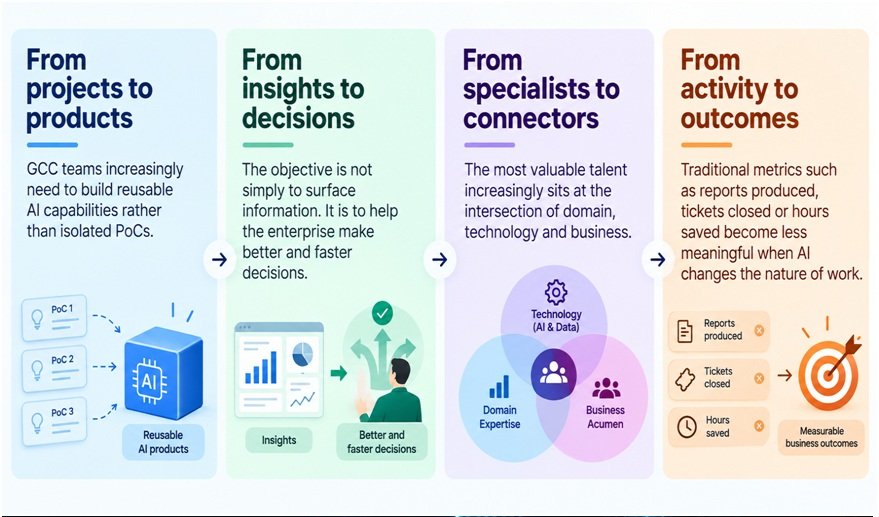
GCC leaders will need to look increasingly at metrics such as:
- Decision speed
- Decision quality
- AI adoption
- Automation impact
- Business value
- Risk reduction
- Customer impact
The exact outcomes will vary by enterprise, but the principle is constant: measure what has transformed because of AI, not simply what AI has produced.
How Can You Tell If a GCC Is Truly AI-Native? |
There is one practical way to know whether a GCC is truly becoming AI-native.
Look at the questions its business stakeholders ask.
If they are still asking:
“Can you build this?”
the GCC may still primarily be operating as a delivery organization.
When the conversation becomes:
“What do you think we should do?”
the relationship has changed.
That is when the GCC starts moving from execution toward judgment, ownership and strategic influence.
And that transition cannot be created by technology alone.
It needs deep domain intelligence, robust data foundations, trust, responsible AI governance, redesigned workflows, and a talent model that connects tech with business outputs.
So, an AI-native GCC is not defined by how much AI is deployed, but by how in-depth it has transformed what GCC owns, how work gets accomplished, and how organizations make decisions.
How Can Polestar Analytics Help Build an AI-Native GCC? |
So, developing an AI native GCC needs more that just embedding AI solutions. It needs data, apt foundations, domain expertise, and operating abilities that push AI initiatives to move from experiments to valuable business impacts.
Polestar Analytics works across this domain, assisting GCC solidify their data foundations, modernize analytics, identify the high-value AI whitespace, and build AI capabilities that can climb across business functions.
For CPG, Retail and Pharma organizations, the objective is not to make the GCC another AI experimentation center.It is to help create the capabilities that allow the GCC to become a trusted, globally integrated business and intelligence partner—one that can identify opportunities, shape decisions, build scalable capabilities and continuously improve how the enterprise operates.
The future of the GCC is therefore not simply AI-powered execution.It is AI-enabled ownership of enterprise outcomes.